
1. Food-Grade Raw Material Selection
Credible thermos manufacturers adopt only safe, durable food-grade stainless steel, mainly 304 and 316 stainless steel.
304 stainless steel is rust-resistant and cost-effective for daily use. 316 medical-grade stainless steel features superior acid and alkali resistance, suitable for juice, carbonated drinks, milk and tea. All raw materials are strictly inspected for purity and flatness before mass production.
2. Cup Body Forming & Shaping
Stainless steel sheets are made into cup shells and inner liners via stamping and deep drawing. Cut steel pieces go through 3-5 times of professional mold stretching to form uniform hollow cup bodies.
Repeated stretching ensures even wall thickness and avoids cracking. Edge trimming removes burrs for smooth, standard cup openings and bottoms. Custom-shaped cups adopt hydroforming for unique streamline designs.
3. Dual-Layer Welding & Assembly
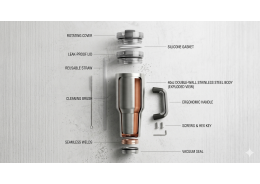
A vacuum thermos cup consists of an outer shell and an inner liner. The two layers are precisely aligned and tightly sealed at the mouth and bottom with laser or argon arc welding.
Seamless airtight welding is critical. Poor welding causes air leakage and invalidates insulation performance. Welded cups are polished and reinforced at the bottom for better stability and anti-slip performance.
4. High-Temperature Vacuum Pumping (Core Process)
Vacuum pumping is the core of thermal insulation. A high-temperature vacuum furnace fully extracts air and moisture from the interlayer between the inner and outer cup layers to create a vacuum state.
The vacuum layer blocks heat conduction and convection to sustain long-term heat and cold retention. Trusted manufacturers apply secondary vacuum treatment for stable performance and fully seal the extraction hole afterward.
5. Precision Polishing & Surface Finishing
Semi-finished cups undergo rough and fine polishing to remove welding marks, scratches and burrs. The smooth inner liner is easy to clean and bacteria-resistant, while the outer shell presents a premium metallic texture.
Optional treatments include matte sandblasting, high-gloss finishing and anti-slip bottom pasting for a refined, wear-resistant surface.
6. Safe Coating, Coloring & Customization
Cups adopt dust-free high-temperature electrostatic spraying with food-safe paint to boost durability and aesthetics. High-temperature baking makes the coating scratch-proof, fade-resistant and odorless.
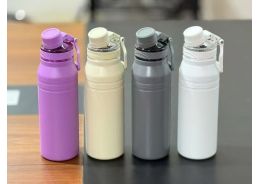
Various finishes are available, including matte, metallic and gradient colors. Brand customization such as laser logo engraving and silk screen printing is fully supported.
7. Strict Quality Inspection & Testing
All finished thermos cups pass rigorous quality tests before packaging to eliminate defective products. Key tests include:
Leak-Proof Test: Cups are fully filled, capped tightly, flipped and shaken repeatedly to ensure no leakage.
Insulation Performance Test: Verify heat and cold retention to meet standard performance requirements.
Air Tightness Test: Check vacuum tightness to prevent insulation failure.
Appearance & Safety Check: Screen for scratches, paint peeling and harmful residue.
Final Packaging
Qualified products are cleaned, dried and packed with protective foam and cartons to avoid transit damage, ready for wholesale and retail shipment.
Final Thoughts
High-quality thermos cups rely on strict production standards. Premium food-grade materials, precise vacuum technology and rigorous quality control jointly determine their durability and insulation performance. Learning about the manufacturing process helps you select cost-effective, reliable insulated cups for resale, customization and daily use.

 English
 German
 French
 Russian
 Spanish
 Japanese
 Korean
 Portuguese
 Ukrainian
 Arabic
 Italian